
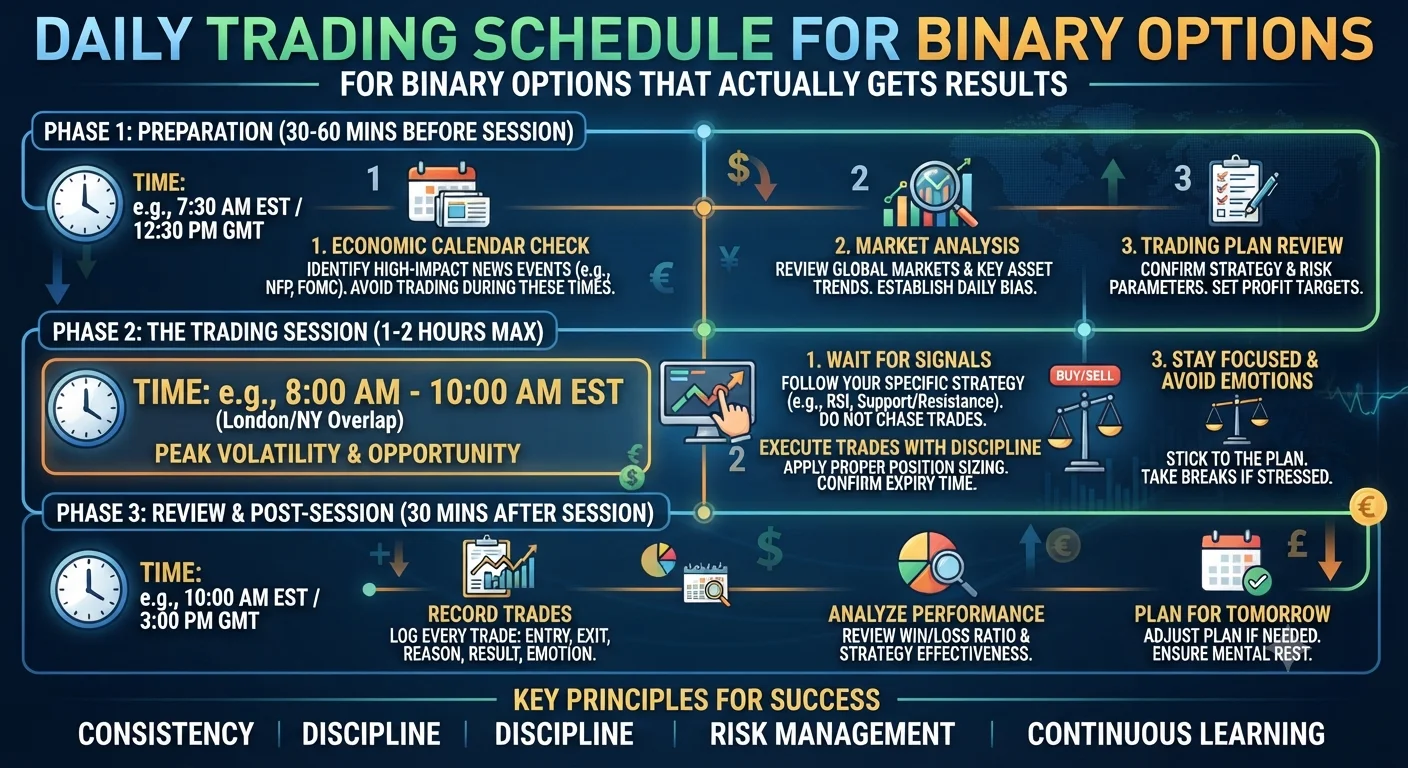
One of the most overlooked habits separating consistently profitable traders from those who struggle is having a structured daily trading schedule. Without one trading often becomes reactive and inconsistent which directly undermines the disciplined approach needed for long term success.
This guide shows you how to build a practical daily schedule you can actually follow.
Why a Daily Trading Schedule Matters
Trading without a schedule often results in sitting in front of charts for extended periods waiting for something to happen or checking markets impulsively at random times throughout the day. Both patterns increase the likelihood of overtrading and emotionally driven decisions that your predetermined strategy and risk management rules were specifically designed to prevent.
- What Are Market Sessions in Trading and Which One Is Best for Binary Options
- What Is the Best Time to Trade Binary Options for Maximum Winning Chances
- What Is Fibonacci Retracement and How Traders Use It to Find Entry Points
A daily schedule creates structure around your trading activity which helps protect the quality of your decision making by ensuring you trade during planned periods rather than impulsively whenever you happen to think about it.
Step One Choose Your Primary Trading Session
- Why a Daily Trading Schedule Matters
- Step One Choose Your Primary Trading Session
- Step Two Define Your Pre Market Preparation Routine
- Step Three Set Your Maximum Active Trading Window
- Step Four Define Your Maximum Trade Count for the Session
- Step Five Schedule a Post Session Review Period
- Step Six Plan Your Rest Days
- A Sample Daily Trading Schedule for Beginners
- Frequently Asked Questions About Daily Trading Schedules
Based on what you learned about global market sessions identify which session best suits your chosen assets and strategy. Most traders benefit from focusing their primary activity during the London session the New York session or ideally the overlap between these two periods for maximum trend clarity and signal reliability.
Write your chosen primary session into your schedule as a fixed daily commitment rather than a flexible suggestion.
Step Two Define Your Pre Market Preparation Routine
Before entering your primary trading window establish a brief preparation routine that runs consistently before each session begins. This routine might include reviewing any relevant economic calendar events scheduled for the day checking the overall trend direction of your chosen assets on a higher time frame chart and confirming your trading plan parameters including risk limits for that specific session.
This preparation period typically takes fifteen to thirty minutes and significantly improves the quality of your in session decision making by ensuring you enter the trading window with relevant context already established rather than starting cold with no prior analysis.
Step Three Set Your Maximum Active Trading Window
Define a specific start and end time for your active trading within your chosen session rather than trading throughout the entire session duration. Many traders find that focusing on the first one to three hours of their primary session produces the best results since this period often shows the strongest and clearest price movements.
Trading for extended continuous periods beyond your defined window increases the risk of decision fatigue which gradually compromises the quality of your analysis and emotional discipline as the session progresses.
Step Four Define Your Maximum Trade Count for the Session
Within your scheduled trading window set a specific maximum number of trades you will place during that session regardless of how many potential opportunities you observe. This limit directly prevents overtrading which is one of the most common causes of unnecessary losses among traders without this specific constraint built into their schedule.
Recommended Articles
 STRATEGIES
 STRATEGIES
 STRATEGIES
 STRATEGIES
Once you reach your maximum trade count for the session stop trading for that day even if additional opportunities appear to present themselves on the chart.
Step Five Schedule a Post Session Review Period
After your active trading window closes build in a specific time for reviewing that session's performance before moving on with the rest of your day. During this review update your trading journal with details of each trade placed including your reasoning and the outcome and note any observations about your emotional state or adherence to your trading plan during the session.
This consistent review habit transforms your daily trading experience into a continuous learning process rather than simply a series of disconnected individual trading sessions.
Step Six Plan Your Rest Days
Most experienced traders schedule specific rest days where they do not trade at all rather than trading every single day without breaks. Rest days allow mental recovery prevent accumulated emotional fatigue and provide perspective on your overall performance without the immediate pressure of active trading decisions.
Many traders find that their performance on trading days improves meaningfully when they maintain regular rest days compared to attempting to trade every single day regardless of their mental state or external life circumstances.
A Sample Daily Trading Schedule for Beginners
Pre session preparation runs from thirty minutes before your chosen session opens and involves reviewing the economic calendar and checking higher time frame trends. Active trading runs during the first ninety minutes to two hours of your primary session with a maximum of three to five trades placed during this window. Post session review runs for fifteen to twenty minutes immediately following your active trading window to update your journal and assess the session.
The remainder of your day involves no trading activity regardless of what you observe on the markets if you happen to check them casually outside your scheduled window.
Frequently Asked Questions About Daily Trading Schedules
How many hours per day should I actively trade binary options Most traders benefit from limiting active trading to one to three hours of focused high quality trading rather than extended continuous sessions that increase decision fatigue and the risk of overtrading.
Should I trade every day of the week Building in regular rest days where you do not trade actively helps prevent mental fatigue and maintains the quality of your decision making on actual trading days rather than grinding continuously without breaks.
What should I include in my pre session preparation routine Reviewing the economic calendar for relevant scheduled events checking higher time frame trend direction and confirming your session risk parameters are practical starting points for an effective pre session preparation routine.
Can my trading schedule change as I gain experience Yes. Your schedule should evolve as you develop clearer understanding of when you personally perform best and which specific market windows consistently produce the most favorable conditions for your chosen strategy.
What happens if I miss my scheduled trading window Skip that session entirely rather than attempting to trade outside your planned window. Maintaining your schedule consistently matters more than capturing every possible session opportunity regardless of circumstances.
Understanding why trading at the wrong time costs you money reinforces why a structured schedule matters so much. Continue reading our guide explaining Why Trading at the Wrong Time Is Costing You Money in Binary Options.
This article is for educational purposes only and does not constitute financial advice. Trading involves risk and you should only invest money you can afford to lose.