
The Martingale strategy is one of the most discussed and most controversial approaches in binary options trading. Some traders swear by it while others consider it one of the fastest ways to lose an entire account. This guide gives you an honest balanced explanation so you can make an informed decision.
What Is the Martingale Strategy
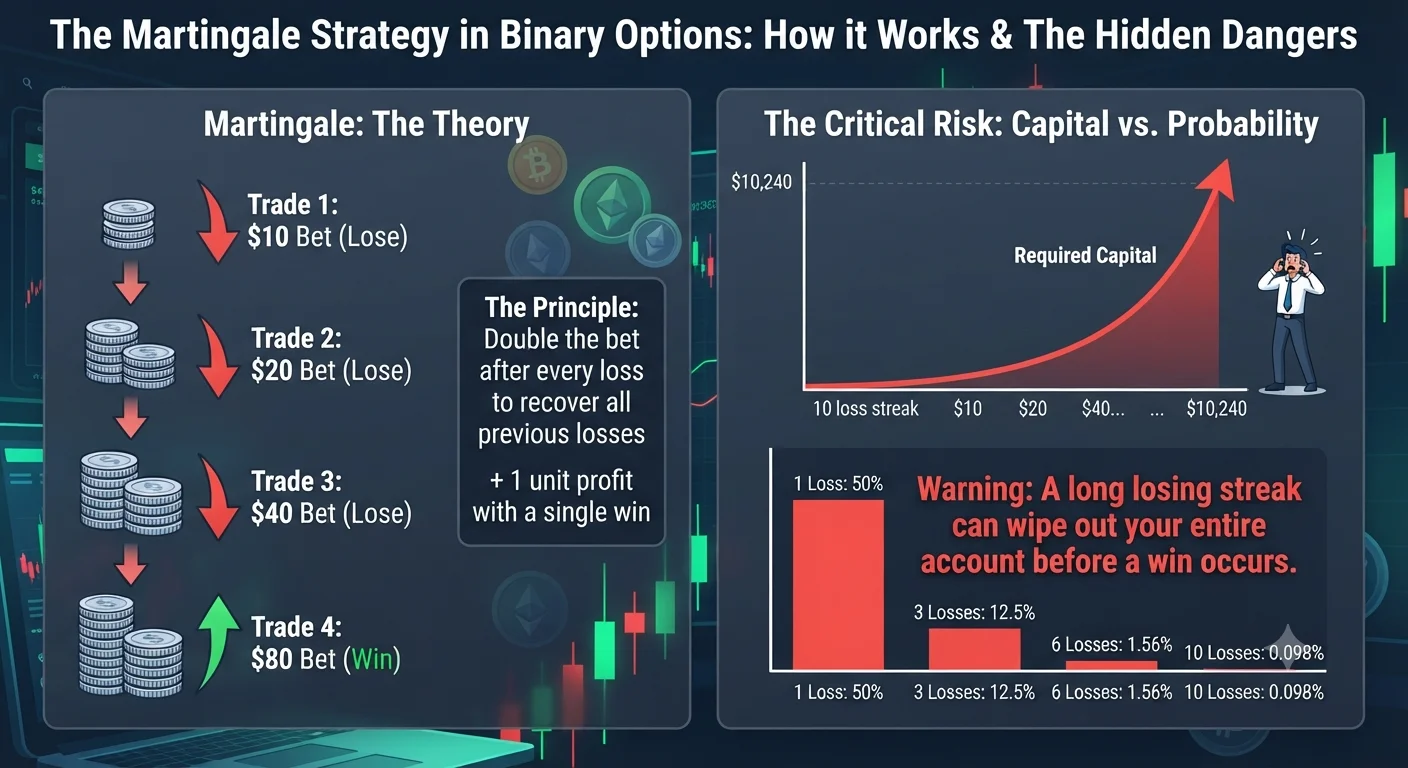
The Martingale strategy involves doubling your trade size after every losing trade with the goal of recovering all previous losses plus generating a profit with a single winning trade. When a winning trade eventually occurs the accumulated profit from that single trade covers all previous losses in the sequence plus adds a small net gain.
For example if you place a five dollar trade and lose you then place a ten dollar trade. If that loses you place a twenty dollar trade. If that wins you recover all previous losses and end the sequence with a net profit equal to your original trade size.
Why the Martingale Strategy Appeals to Traders
- What Is the Martingale Strategy
- Why the Martingale Strategy Appeals to Traders
- The Critical Problem With Martingale in Practice
- Why Losing Streaks Are More Common Than Expected
- Modified Martingale Approaches
- Should You Use the Martingale Strategy
- What to Use Instead of Martingale
- Frequently Asked Questions About the Martingale Strategy
The mathematical logic behind Martingale appears straightforward and reassuring at first glance. Since you cannot lose indefinitely in theory a winning trade must eventually occur which will recover everything lost in the sequence before it. This creates the impression of a strategy that cannot ultimately fail given enough capital and patience.
- Why Trading at the Wrong Time Is Costing You Money in Binary Options
- How to Build a Daily Trading Schedule for Binary Options That Actually Gets Results
- What Are Market Sessions in Trading and Which One Is Best for Binary Options
This appeal is genuine but the reality of applying Martingale to actual trading reveals serious practical limitations that this theoretical framing obscures entirely.
The Critical Problem With Martingale in Practice
The most dangerous aspect of the Martingale strategy is how quickly trade sizes escalate during extended losing sequences. Starting with a five dollar trade a sequence of just eight consecutive losses requires a trade size of one thousand two hundred and eighty dollars on the ninth trade simply to recover the previous losses and achieve a small net gain.
This exponential growth in required trade size means even moderately long losing streaks which occur regularly in normal trading can quickly exceed either your total account balance or your platform's maximum trade size limit. When either of these limits is reached before a winning trade occurs the entire sequence results in a catastrophic loss of all funds committed to that sequence.
Why Losing Streaks Are More Common Than Expected
Many traders underestimate how frequently extended losing streaks occur even with genuinely effective strategies. A strategy winning sixty percent of trades over the long term will still regularly produce sequences of five six or even seven consecutive losses due to natural statistical variation in outcomes.
These statistically normal losing sequences become financially catastrophic when combined with the exponentially growing position sizes required by the Martingale approach even though the same losing sequences are entirely manageable under a standard fixed percentage risk management approach.
Modified Martingale Approaches
Some traders use a modified version of the Martingale that increases trade size by a smaller multiplier such as one and a half times rather than doubling after each loss. This reduces the speed of escalation somewhat though it does not eliminate the fundamental risk of exponential position size growth during extended losing sequences.
Recommended Articles
 STRATEGIES
 STRATEGIES
 STRATEGIES
 STRATEGIES
Any approach involving systematic position size increases after losses carries a version of the same core risk inherent in the original Martingale regardless of the specific multiplier used.
Should You Use the Martingale Strategy
For most beginners the honest recommendation is to avoid the Martingale strategy until you have extensive experience with disciplined fixed risk trading and a thorough understanding of your strategy's statistical performance over a large sample size. Even then the risks involved make it a strategy that demands extreme caution and strict account size requirements to apply responsibly.
Many experienced traders with years of consistent results still choose to avoid Martingale entirely preferring the predictable controlled risk exposure offered by standard percentage based risk management over the theoretical recovery appeal of position doubling approaches.
What to Use Instead of Martingale
Standard percentage based risk management limiting each trade to one to five percent of your total account balance provides consistent controlled risk exposure without the exponential escalation risk inherent in Martingale approaches. This approach allows you to survive normal losing streaks while continuing to trade and develop your skills rather than risking account elimination during a statistically normal sequence of consecutive losses.
Frequently Asked Questions About the Martingale Strategy
Is the Martingale strategy guaranteed to eventually work Theoretically yes but the practical limitation is that the required trade sizes during extended losing streaks frequently exceed either your available account balance or your platform's maximum trade size before a winning trade occurs which results in catastrophic losses.
Can Martingale work on a large account A larger account reduces but does not eliminate the risk since sufficiently long losing sequences will eventually exceed even very large account balances when position sizes are doubling after every loss.
What is a modified Martingale approach A modified version uses a smaller multiplier than doubling such as increasing by one and a half times after each loss which reduces the speed of escalation though the fundamental risk of exponential growth during losing sequences remains present.
Is Martingale suitable for beginners Most experienced traders recommend beginners avoid the Martingale strategy and instead develop consistent skills using standard fixed percentage risk management before considering any position escalation approaches.
What is the safest alternative to Martingale Standard percentage based risk management limiting each trade to one to five percent of total account balance provides consistent controlled risk exposure without the catastrophic escalation risk inherent in Martingale approaches.
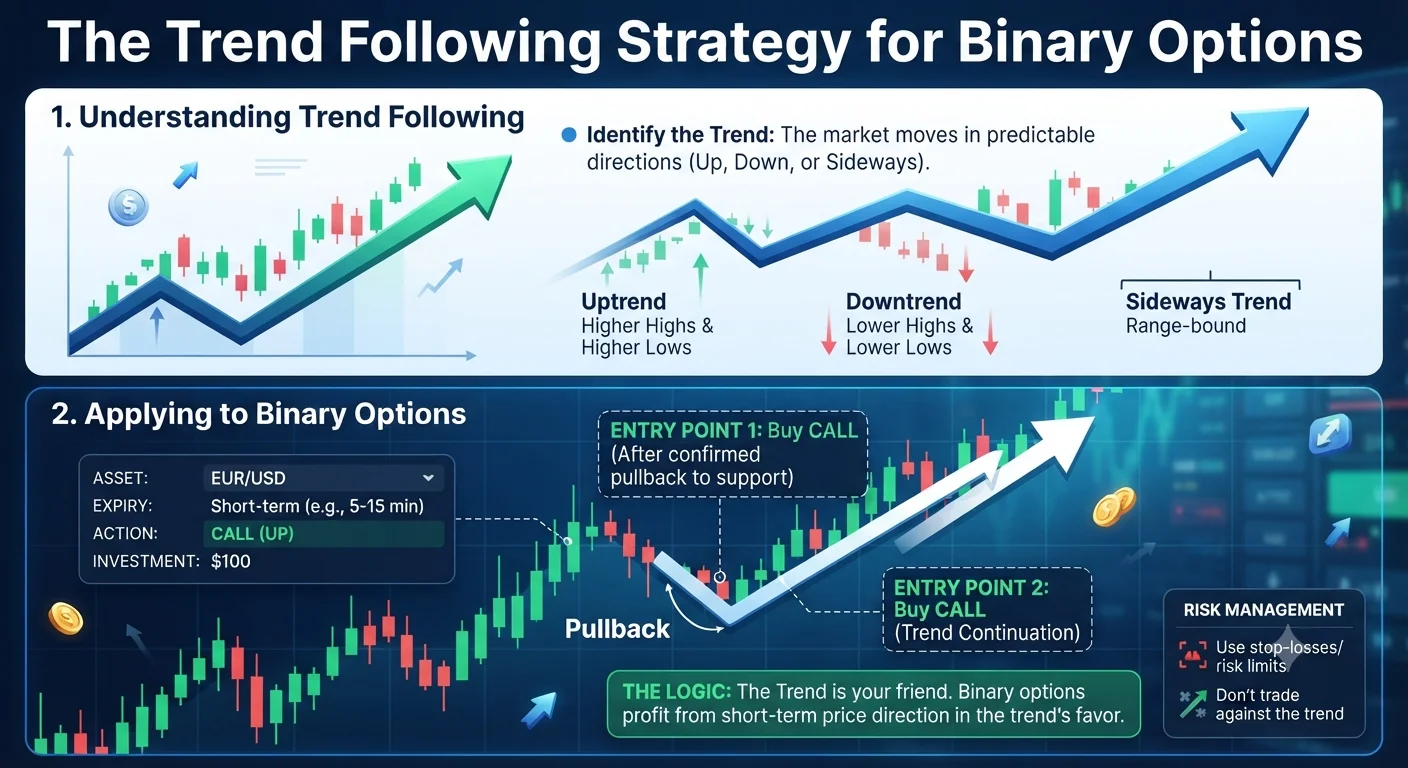
Understanding trend following strategies provides a much safer foundation for consistent trading results. Continue reading our guide on what the trend following strategy is and how to apply it to binary options trades.
This article is for educational purposes only and does not constitute financial advice. Trading involves risk and you should only invest money you can afford to lose.