
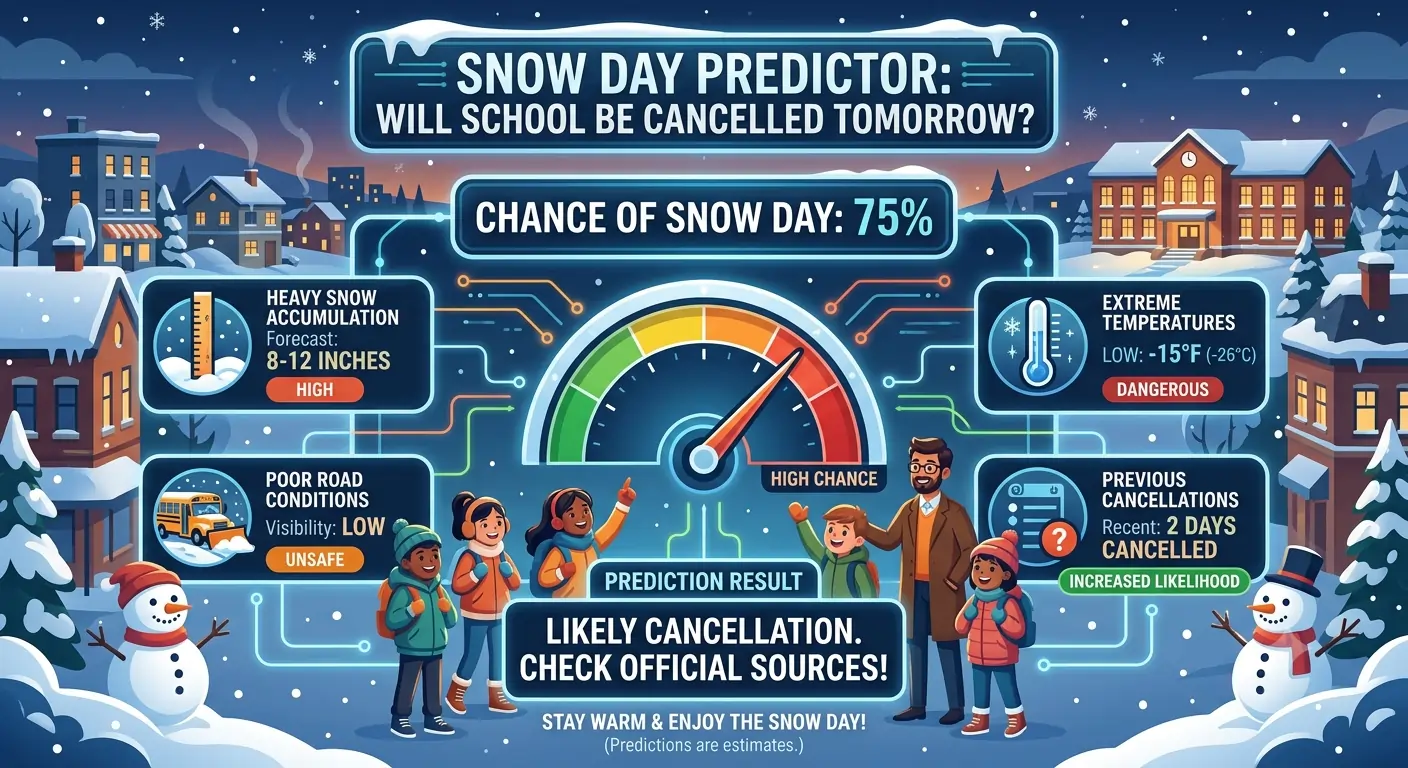
What Is a Snow Day Predictor
A snow day predictor is a free online tool that tells you the probability of your school closing due to winter weather before the superintendent even makes the call. Instead of guessing by looking at clouds outside your window a snow day predictor relies on real data including weather forecasts and snowfall amounts and storm intensity and historical school closure patterns to provide a much more reliable estimate. Predict snow day
You simply enter your ZIP code or city name. Within seconds you receive a probability score that tells you exactly how likely a school closure is for your location. This is the tool that students and parents and teachers across the United States rely on every winter season to plan ahead with confidence.
How Does a Snow Day Predictor Work
- What Is a Snow Day Predictor
- How Does a Snow Day Predictor Work
- What Factors Does a Snow Day Predictor Analyze
- How Accurate Is a Snow Day Predictor
- Snow Day Predictor vs a Regular Weather App
- Who Should Use a Snow Day Predictor
- When Is the Best Time to Check a Snow Day Predictor
- Snow Day Predictor and Remote Learning Days
- How to Read Your Snow Day Predictor Result
- Final Answer: What Is the Best Snow Day Predictor
School closure decisions are not based on snowfall alone. Districts weigh several factors at once. The calculator combines seven real weather variables to estimate the chance of closure including snow accumulation and wind chill and ice and freezing rain and morning timing and wind speed and visibility and district policy. Snow Day Calculator
Here is what happens behind the scenes when you use a snow day predictor:
Live Weather Data Collection
The system pulls live weather information including temperature and snowfall predictions and wind speed and ice accumulation from trusted meteorological sources. This data updates automatically every three hours.
The Critical Morning Window
The system analyzes hour by hour atmospheric changes to tell you exactly when the roads will become impassable tracking the Morning Crunch which is the critical window between 4:00 AM and 7:00 AM that determines whether a superintendent calls for a closure or a delay.
Regional Adjustment
The algorithm applies regional multipliers. Southern states get a 1.5x multiplier because schools close more easily while northern states get a 0.8x multiplier because of more winter ready infrastructure. Mountain and western states have their own calibrations.
Final Probability Score
The result is shown as a percentage from 0% to 100%. A score of 80% or higher means a snow day is very likely. A score between 55% and 80% signals a high chance of closure to watch for early in the morning. A score between 30% and 55% suggests a possible snow day or delayed start. A score below 10% means no snow day is expected and school should run as scheduled. Snow Day Predictor
What Factors Does a Snow Day Predictor Analyze
Snowfall Amount
Generally 1 to 2 inches indicates a possible closure in southern states. Three to 4 inches means a likely closure in most regions. Five or more inches points to an almost certain closure nationwide.
Ice and Freezing Rain
Ice is more dangerous than snow. Even 0.1 inch of ice can cause school closures because roads become impassable and walking surfaces become dangerously slippery.
Storm Timing
Superintendents focus on the 5:00 AM to 7:00 AM window. Once the accumulation rate exceeds 1 inch per hour municipal equipment cannot keep the roads clear between passes. This accumulation rate is the number one trigger for a full closure.
Wind Chill and Cold Days
Over 60% of school closure decisions are based on road conditions and bus safety not just snowfall totals. Storm timing and ice risk and wind chill are the same factors school superintendents use when making the call.
District Policy and Infrastructure
Schools in the Great Lakes region and New England are built for winter. Plows are prestaged. Salt trucks run all night. These districts typically only close for genuinely severe events such as heavy accumulation over 8 to 10 inches or dangerous ice or extreme cold warnings. A four inch snowfall in Buffalo is just a Tuesday.
Black Ice Risk
If the ground has been below freezing for 48 hours even a light dusting will create a sheet of black ice. Superintendents check ground temperature as part of the closure decision process.
How Accurate Is a Snow Day Predictor
Accuracy is highest at 85% to 90% when checked 12 to 18 hours before the storm. Predictions made 3 to 5 days out are directional only because forecast models become significantly more reliable within 24 hours of the event.
When a snow day calculator predicts a probability of 90% or higher for a given location those schools actually close 97% of the time. The model is retrained at the start of each winter season using the previous year's full dataset of closure events so improvements compound over time.
Recommended Articles
 GENERAL KNOWLEDGE
 GENERAL KNOWLEDGE
 GENERAL KNOWLEDGE
 GENERAL KNOWLEDGE
The remaining cases where predictions miss usually come down to what experts call the Superintendent Factor. These are scenarios where objective weather data clearly indicates conditions for closure but the district remains open anyway. Common causes include districts that have already exhausted their annual snow days or political pressure to avoid extending the school calendar.
Snow Day Predictor vs a Regular Weather App
A standard weather app tells you how much snow is forecast. A snow day predictor answers the question you actually care about which is whether school will be closed tomorrow.
- What Is an Instagram Story Viewer
- Word Search: The Timeless Puzzle That Sharpens Your Mind and Feeds Your Curiosity
A weather app tells you how much snow is forecast. The calculator translates that data into the question you actually care about. Snow accumulation alone is a poor predictor of school closures because it ignores timing and ice and wind chill and district behavior. A 70% snow day chance in a northern Vermont town and a 70% chance in suburban Atlanta both mean the same thing which is that closure is likely even though the underlying weather is completely different. That is the value of a probability based tool over a raw weather forecast.
Who Should Use a Snow Day Predictor
Students get an early read on whether tomorrow is a school day so they can plan their evening accordingly.
Parents use the predictor to arrange childcare or remote work schedules before the official announcement arrives. A snow day predictor removes the uncertainty from winter planning making life simpler and safer for everyone.
Teachers use it to decide whether to prep detailed lesson plans or prepare for a flexible day.
Working Adults use it to plan commute alternatives and check whether their office or workplace is likely to announce a closure.
More than five million people check a snow day predictor each winter in the United States alone with over 100 million annual visits to the leading prediction platforms.
When Is the Best Time to Check a Snow Day Predictor
Check between 8 PM and 10 PM the night before a forecasted storm. Bookmark the page and return to it the night before any winter weather event. Most snow day decisions follow predictable weather thresholds that the tool detects early.
Most school districts follow a fairly predictable announcement timeline. The night before between 5 PM and 10 PM some superintendents prefer to make early announcements so families have maximum preparation time. Early announcements are more common when storms are well forecasted and there is high confidence in the closure decision.
For the most accurate result check the predictor again early in the morning between 5 AM and 6 AM as most districts make their final call in that window.
Snow Day Predictor and Remote Learning Days
One thing worth knowing in 2026 is that a school closure does not always mean a full day off. Many districts now convert snow days into virtual instruction rather than canceling classes entirely. A good snow day predictor flags this distinction in its output noting the difference between a full closure and a remote learning day.
In 2026 many districts have moved back toward preserving traditional snow days recognizing the wellbeing value of a true break for student mental health. Whether your district goes virtual or fully closes knowing the night before is what matters most.
How to Read Your Snow Day Predictor Result
Here is a quick guide to interpreting the probability score your predictor returns:
Below 30% means school is very likely open. Plan for a normal morning.
30% to 55% suggests borderline conditions. A 2 hour delay is possible. Keep an eye on official announcements from your district.
55% to 80% signals a high likelihood of closure or delay. Arrange backup plans the night before.
Above 80% means closure is very likely. Check for official announcements by 6 AM as most school districts announce closures by that time. Snow Day Calculator
Always confirm the final decision through your school district website or official communication channels. The predictor gives you the best possible advance warning. The superintendent makes the final call.
Final Answer: What Is the Best Snow Day Predictor
The best snow day predictor is one that combines live National Weather Service data with historical closure patterns for your specific school district and adjusts for regional infrastructure and storm timing. It delivers a clear probability score updated every few hours so you always have the most current picture available.
Use thesnowdaycalculators.com to get your personalized snow day prediction tonight. Enter your ZIP code and find out whether tomorrow belongs to school or to snow. ❄️