
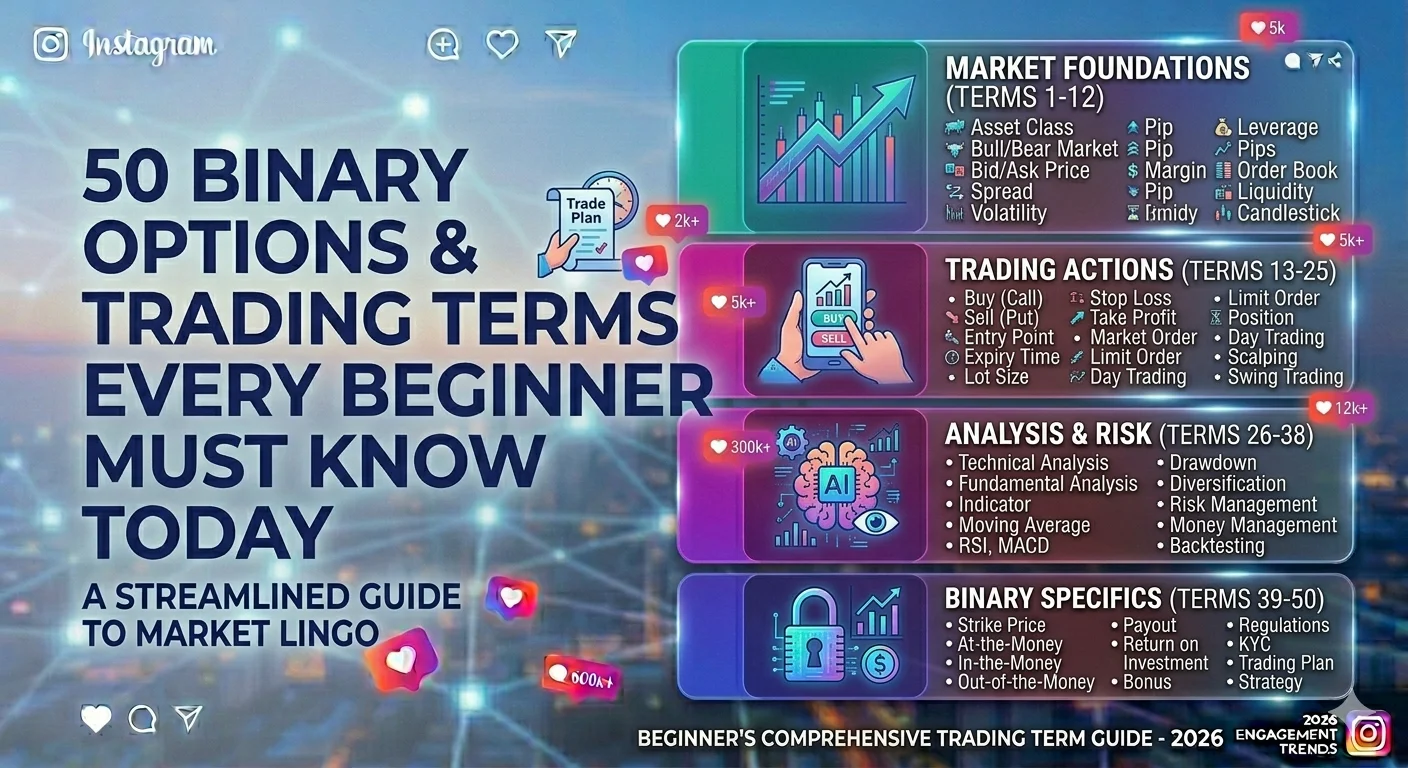
Trading has its own language and understanding that language is the first step toward becoming a confident trader. Below you will find fifty essential terms every binary options trader should know explained in plain simple language.
Bookmark this page and return to it whenever you come across a term you do not recognize.
Basic Trading Terms
Binary Options A type of trade where you predict whether the price of an asset will rise or fall within a fixed time period. The outcome results in either a fixed profit or a complete loss of the invested amount.
Call Option A prediction that the price of an asset will rise before the expiry time ends.
Put Option A prediction that the price of an asset will fall before the expiry time ends.
Strike Price The exact price level at the moment you place a trade. Your prediction is measured against this price when the trade expires.
Expiry Time The moment a trade closes and the result is determined. Common expiry times range from sixty seconds to several hours.
Payout The amount of profit you receive when a trade closes successfully. This is usually expressed as a percentage of your initial investment.
In the Money A term used when your prediction was correct and the trade closes with a profit.
Out of the Money A term used when your prediction was incorrect and the trade closes with a loss.
Demo Account A practice account that allows you to place trades using virtual money instead of real funds. Ideal for beginners learning the platform.
Underlying Asset The financial instrument you are trading such as a currency pair stock commodity or index.
Market and Price Terms
Bid Price The price at which you can sell an asset in the market.
Ask Price The price at which you can buy an asset in the market.
Spread The difference between the bid price and the ask price.
Volatility A measure of how much and how quickly the price of an asset moves over a given period of time.
Liquidity How easily an asset can be bought or sold without significantly affecting its price.
Trend The general direction in which the price of an asset is moving over time whether upward downward or sideways.
Support Level A price point where an asset historically tends to stop falling and reverse upward.
Resistance Level A price point where an asset historically tends to stop rising and reverse downward.
Breakout When the price of an asset moves beyond a established support or resistance level.
Reversal A change in the direction of a trend from upward to downward or from downward to upward.
Chart and Technical Analysis Terms
Candlestick Chart A visual representation of price movement showing the open high low and close price for a specific time period.
Bullish A term describing market conditions or price action that suggests prices will rise.
Bearish A term describing market conditions or price action that suggests prices will fall.
Moving Average A technical indicator that smooths out price data by calculating the average price over a specific number of periods.
RSI Short for Relative Strength Index. An indicator used to measure whether an asset is overbought or oversold.
MACD Short for Moving Average Convergence Divergence. An indicator used to identify changes in momentum and trend direction.
Bollinger Bands A technical indicator consisting of three lines that measure volatility and potential price reversal points.
Fibonacci Retracement A tool used to identify potential support and resistance levels based on key mathematical ratios.
Pin Bar A candlestick pattern that often signals a potential reversal in price direction.
Time Frame The duration represented by each candlestick on a chart such as one minute five minutes or one hour.
- Binary Options vs Forex Trading What Is the Real Difference You
- What Is Binary Options Trading and How Does It Work for Beginners
Risk and Money Management Terms
Risk Management The practice of controlling how much money you risk on each trade to protect your overall capital.
Recommended Articles
 TRADING BASICS
 TRADING BASICS
 TRADING BASICS
 TRADING BASICS
Position Size The amount of money allocated to a single trade.
Capital The total amount of money you have available for trading.
Drawdown The reduction in your trading capital after a series of losing trades.
Stop Loss A predetermined exit point used to limit losses on a trade. More commonly used in forex and stock trading than binary options.
Take Profit A predetermined exit point used to lock in profits on a trade.
Money Management Plan A structured approach to deciding how much to risk per trade based on your total available capital.
Overtrading Placing an excessive number of trades often driven by emotion rather than strategy which typically leads to losses.
Martingale Strategy A high risk strategy where traders double their investment after a loss in an attempt to recover previous losses with a single win.
One Percent Rule A risk management principle suggesting traders should never risk more than one percent of their total capital on a single trade.
Platform and Broker Terms
Broker The company or platform through which you place trades.
Regulation Official oversight by a financial authority that ensures a broker operates fairly and transparently.
Withdrawal The process of transferring your funds from a trading platform back to your personal bank account or payment method.
Deposit The process of adding funds to your trading account.
Minimum Deposit The smallest amount of money required to open an account or begin trading on a specific platform.
Trading Signal A suggestion or alert indicating a potential trading opportunity based on technical or fundamental analysis.
Leverage The ability to control a larger position size using a smaller amount of capital. More common in forex trading than binary options.
Spread Betting A different form of trading where profit or loss is determined by how accurately you predict price movement rather than a fixed payout structure.
Psychology and Strategy Terms
Trading Psychology The emotional and mental discipline required to make rational trading decisions without being influenced by fear or greed.
FOMO Short for Fear of Missing Out. An emotional reaction that leads traders to enter trades impulsively without proper analysis.
Discipline The ability to stick to a predetermined trading plan regardless of emotional impulses during live trading.
Win Rate The percentage of trades that result in a profit out of the total number of trades placed.
Trading Journal A record kept by traders to track their trades reasoning and outcomes in order to identify patterns and improve performance over time.
Frequently Asked Questions About Trading Terminology
What is the most important term for beginners to understand first Understanding the difference between a call option and a put option is the most fundamental concept since every single trade depends on choosing one of these two directions correctly.
Do I need to memorize all fifty terms before trading No. Start with the basic trading terms and risk management terms first since these apply to every trade you place. You can gradually learn the technical analysis terms as you gain experience.
Are these terms the same across all binary options platforms Yes. While platform interfaces may differ the core terminology used in binary options trading remains consistent across the industry.
What is the difference between volatility and liquidity Volatility measures how much a price moves over time while liquidity measures how easily an asset can be bought or sold without affecting its price. These are two separate but related market characteristics.
Now that you understand the core vocabulary of binary options trading you are ready to explore how these concepts apply in real trading situations. Continue your learning with our complete guide on what binary options trading is and how it works for beginners.
This glossary is for educational purposes only and does not constitute financial advice. Understanding terminology is one part of becoming a responsible trader and should be combined with proper risk management and continued education.